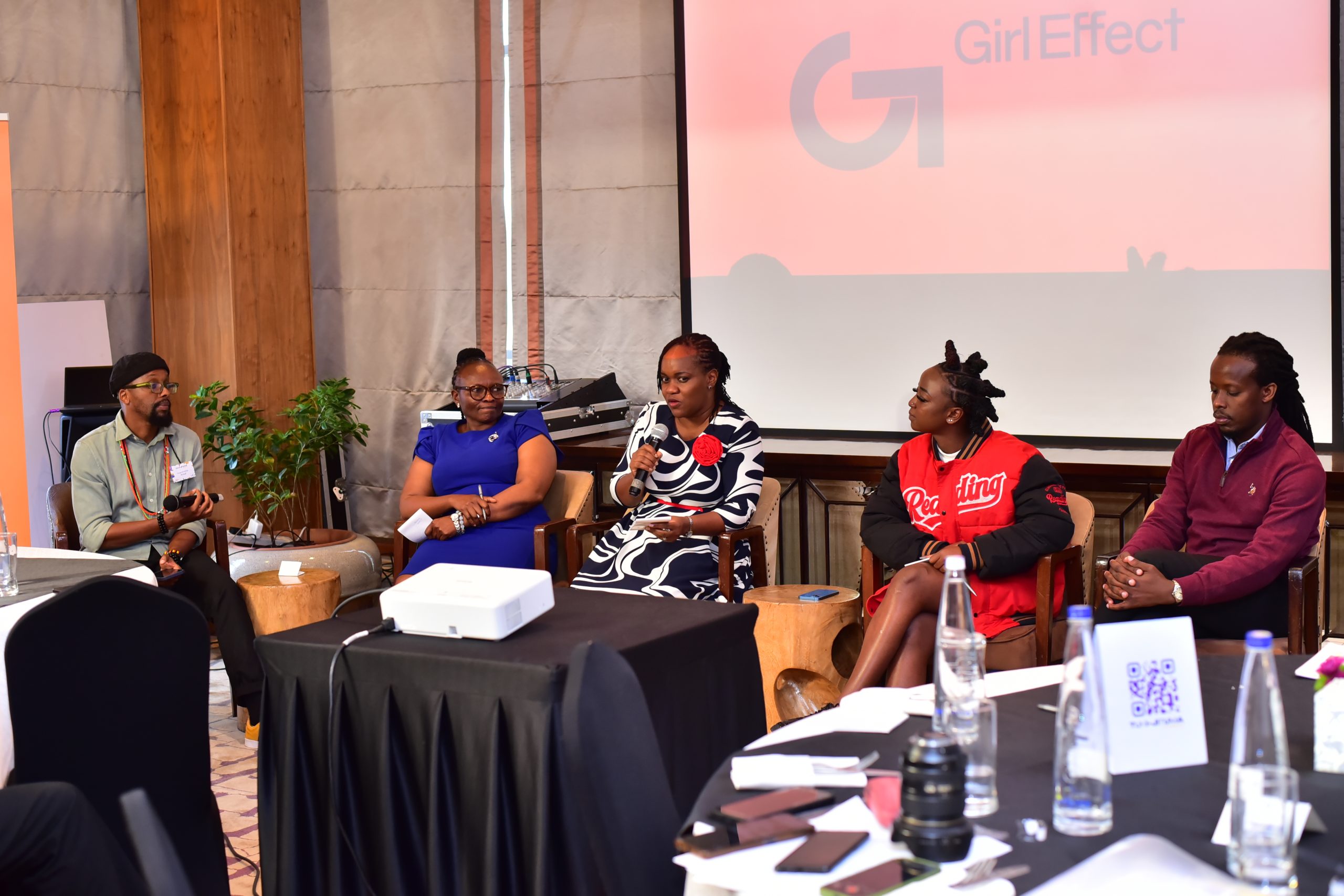
I recently turned 26. And this new age has me loving my femininity in ways I didn’t expect. It has me feeling more confident, more certain of who I’m becoming. I find myself drawn to spaces where young people are building, creating, leading—not because I want to compare myself to them, but because I want to learn. I want to see what’s possible when our generation refuses to accept limits placed on us.
When I finally met Nikole Wintermeier, Girl Effect’s Communications Consultant, after she’d invited me to the Tuki-Jituma launch event, she told me something that stuck with me: “See this as a breath of fresh air.” I didn’t fully understand what she meant until the conversations in that room began.
A Room Full of Possibility
Breakfast was served, but the real nourishment was in the air—conversations about youth unemployment, digital economies, creative industries, and the stubborn statistic that 67% of Kenya’s youth are unemployed. These weren’t just numbers on a slideshow. They were the lives of people I know. People like me.
Tukijituma, which means “Together We Thrive,” is Girl Effect’s new partnership with the Citi Foundation. It’s a $500,000 initiative designed to reach one million young Kenyans with economic empowerment content, and directly train 5,000 youth in Nairobi and Migori. While the program has a strong focus on adolescent girls and young women who face additional barriers in accessing opportunities, it’s designed to empower all young people navigating Kenya’s challenging job market.
The goal? To equip youth with certifications in creative and digital industries, connect them to mentorships, apprenticeships, and actual jobs.
The program promises 3,000 youth linked to markets, 1,000 internships, 1,000 apprenticeships, and 1,000 mentorship opportunities. Big numbers. Bold promises. But what struck me most wasn’t the scale—it was the intentionality. This wasn’t a generic “youth empowerment” pitch. It was specific. Practical. Rooted in the reality that Kenya’s creative economy is booming, but access to it remains painfully unequal for young people, especially those from low-income households, informal settlements, and underserved rural areas.
The Women Who Showed Me What’s Possible
Shanty Bobo opened the event with a performance that made the room pulse. She’s a global artist performing in Kenya, and her message was simple but powerful: Wangapi wanajinawo? How many of you believe in yourselves?
I raised my hand. And I meant it.
Then came the speeches. Marianne Wanjiku, Director of Public Affairs at Citi Sub-Saharan Africa, stood at the front and spoke with the kind of clarity that only comes from over 20 years of experience in financial services. She talked about her father—a farmer who was actually exporting horticulture and flowers to Europe, but whom she couldn’t see as an entrepreneur because society had taught her to look for titles like “CEO.” She spoke about how opportunity isn’t evenly distributed, how young people have the talent but lack the networks and frameworks to leverage it.
I kept looking at her—polished, articulate, present, previously serving as Citibank’s public affairs officer for East Africa across Kenya, Uganda, Tanzania, and Zambia—and thinking, If she made it, I can too.
Jessica Posner Odede, Girl Effect’s CEO and New York Times best-selling author, followed with a message that hit differently. A recognized social entrepreneur who co-founded Shining Hope for Communities (recipient of the Conrad N. Hilton Humanitarian Prize in 2018), she didn’t shy away from the hard truths. Yes, 80% of young people in Kenya are employed. But is that employment meaningful? Dignified? Empowering? She challenged us to think beyond survival and toward thriving. She asked: How do we create spaces where young people—especially those who face the most barriers—can not just access opportunities, but own them?
I felt seen in that moment. Because I know what it’s like to hustle and still feel stuck. To have ambition but lack the right doors to knock on.
The room also included representation from the government— Wanjiru Wanjoki, Assistant Director for Youth Development in the Directorate of Innovation and Talent Development at the State Department of Youth Affairs and Creative Economy, and officials from TVET—all signaling that this wasn’t just another NGO event, but a multi-stakeholder commitment to addressing youth unemployment at scale.
What This Means for Gen Z Women Like Me
As a young mother, I think a lot about legacy. Not in the grand, history-book sense, but in the everyday sense. What am I modeling for my daughter? What world am I helping to build for her?
The program’s scope is significant: reaching one million young people through curated digital content, directly training 5,000 youth in Nairobi and Migori (with a strong focus on those from low-income households and informal settlements), and creating tangible pathways through 3,000 market linkages, 1,000 internships, 1,000 apprenticeships, and 1,000 mentorship opportunities.
But beyond the numbers, what moved me was the intentionality around young women. Nancy Njoki, Girl Effect’s Country Director, made it clear that while the program serves all youth, there’s deliberate focus on adolescent girls and young women who face compounded barriers in accessing Kenya’s creative and digital economies.
I want her to grow up knowing that her mother didn’t just accept the world as it was. That I showed up. That I asked questions. That I sat in rooms with women who were doing the work—not perfectly, not without struggle—but persistently.
I want her to know she comes from a lineage of women who didn’t stop. Women who were passionate about their work, about the next generation, about possibility. And that she has their blessing to be as great as she wants to be.
Tukijituma isn’t perfect. I left the event with questions: Will these certifications actually lead to jobs, or just more certified unemployment? How will rural youth in Migori access digital platforms when infrastructure is still a challenge? What happens after the two-year grant runs out?
But I also left with something else—hope. Not the naive kind, but the grounded kind. The kind that comes from seeing women in leadership who look like you, who understand the barriers, and who are willing to try something new. Women like Marianne, Jessica, Nancy, and Nikole who aren’t just talking about change but actively building the infrastructure for it.
The Breath of Fresh Air
Nikole was right. The event was a breath of fresh air. Not because it had all the answers, but because it reminded me that change doesn’t happen in isolation. It happens when we gather. When we share resources. When we mentor. When we refuse to let another generation of young women believe they’re not enough.
The performance by Shanty Bobo set the tone perfectly. Wangapi wanajinawo? she asked—How many believe in themselves? It wasn’t just a performance; it was a call to action. A reminder that self-awareness and self-belief are the foundation upon which all opportunity is built.
As I look toward my future—building my career, raising my daughter, figuring out this thing called adulthood—I’m learning that femininity isn’t soft in the way I once thought. It’s fierce. It’s strategic. It’s collaborative.
And if women like Marianne Wanjiku, Jessica Posner Odede, Nancy Njoki, Nikole Wintermeier, and the young creators I met that day can carve out space in industries that weren’t built for them, then so can I.
