A creator with a million followers can still end up owning nothing.
That was the uncomfortable point running through the Creator and Influencer Economy Roundtable at CANEX WKND 2026 in Lagos. Part of the IP Rights Summit, the session brought together lawyers and music and creator-economy figures to ask a plain question: what does a creator actually own?
This question sat at the heart of CANEX. The argument was that African creatives need more than talent and visibility. They need to keep the value of what they make. Especially for creators and influencers, whose work lives on platforms and in brand deals, that comes down to contracts, copyright, and who holds the rights.
The panel included entertainment and IP lawyer Amy Oraefo, who splits her time between Atlanta and Lagos. She runs her own boutique firm, advises artists in the United States and Nigeria, and has negotiated deals involving brands including Universal Music Group, Meta and Puma. She is also CEO and co-founder of Replete Music Publishing. Also on stage were Sandra Oyewole, a Lagos-based partner at Olajide Oyewole LLP, the Nigerian member firm of DLA Piper Africa, where she leads the Intellectual Property and Technology practice; an IP lawyer from the firm Jackson, Etti & Edu; Oladapo Adewunmi, founder and CEO of Apollo Endeavor and convener of the African Creators Summit; and Marc-André Niang, co-director of Warner Music Africa Francophone, a venture operating in France and French-speaking sub-Saharan Africa.
Visibility is not income
Building an audience and building a business aren’t the same, and the panel clearly stated where the gap lies. Creators think as influencers, but those who want to last have to think as owners.
“You are an entity and a brand,” Amy Oraefo told the room. She advised creators to stop being “happy to be visible” and start negotiating, because what a creator gets depends on what they ask for. Followers, she said, are not the prize:
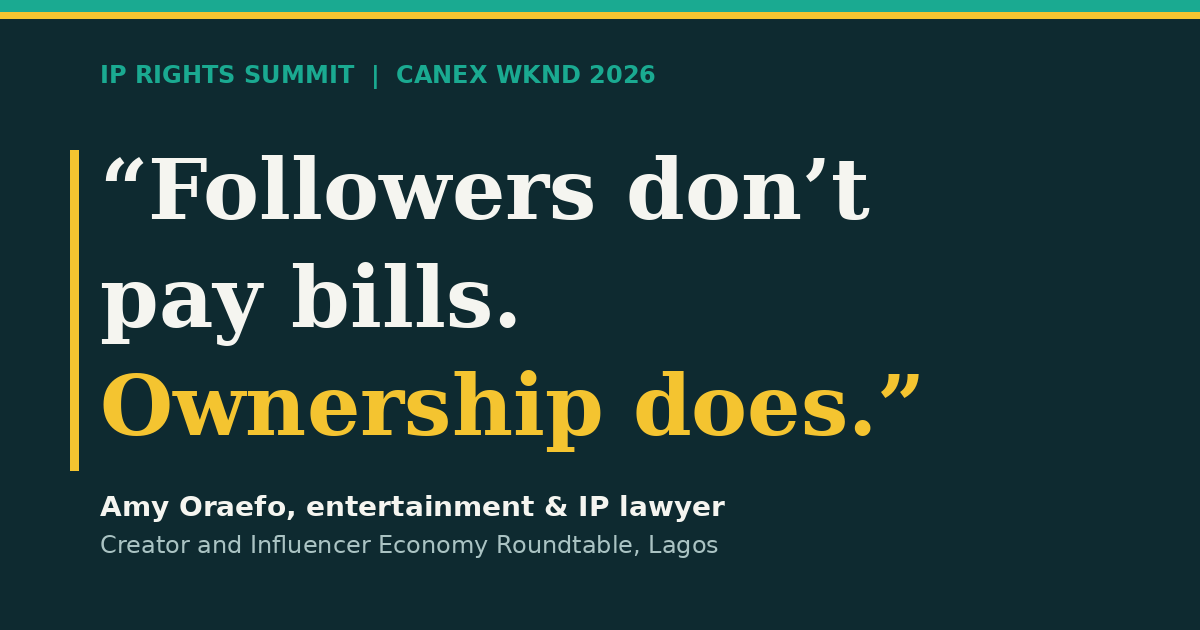
“Stop being excited to be in the room. You are there. You have value. So negotiate. Start thinking about ownership. Stop being happy to be visible. Followers don’t pay checks. They don’t pay bills. Ownership does.”
Because the law decides what counts, she said, creators should work with seasoned IP lawyers who are also “business-minded,” and not only specialists in the legislation. Her colleague from Jackson, Etti & Edu added that a creator setting up a business needs financial advice on questions such as taxes, fair payment, and whether their craft is being valued properly. Creators have their own skills and strengths, she said, “but then you have to come to the people that know.”
Ownership can be built early. Oladapo Adewunmi, who is not a lawyer, urged creators to develop original characters, stories and scripts that can then be registered, and to put together a team to handle contracts, insurance and tax.
The panelists added a warning. Marc-André Niang told creators to study their data, but to remember that “you don’t own what you post.” He added that artists are now expected to be content creators too, describing TikTok as the new MTV.
Licence or sale: Know which one you’re selling
Not every creator can afford a lawyer straight away, the moderator noted, so how can they understand the difference between licensing and assigning their rights when negotiating a brand deal?
Oyewole’s first answer was about education. She has long argued that IP should be taught in schools, “the same way mathematics, biology, et cetera is taught,” because technology, and the IP that underpins it, is everywhere. On cost, she said legal fees are a real concern, but creators can’t know what they will pay until they converse. Lawyers in this field, she said, have practices that grow as their clients grow, and creators can negotiate. Her advice was to talk to a lawyer before signing.
Oraefo said she and her fellow lawyers are not raising the issue to drum up work.
“We’re not saying it because we’re lawyers. We’re saying it because unfortunately, we’ve seen the other side. I’m a transactional lawyer, which means I like to get in front of things to help you make money and to protect. If somebody has stolen or infringed upon your work, now you pay two lawyers. What’s more costly, paying for one or two?”
She described calls she has taken from people with songs on the Billboard top 40. “They said,’ That’s my song. I believe them. I do. But they did not own the copyright.”
The difference, she explained, comes down to how rights are transferred: through a licence or through work for hire. Her example turned on money.
“The very thing that makes you money is what you’re handing over to somebody. You give somebody $2,100 for a record, and you make a million dollars, you’re not getting back in residual. You get no royalty streams. That’s a licence versus a work for hire.”
With a licence, she said, rights return to the creator after a term, and anyone who wants to keep using the work has to pay for a new one. “That is leverage, that is power.” Her bottom line: “You license something, and it reverts to you, or you outright sell it. If you’re going to sell it, make sure the price and the terms make sense for you.”
The IP lawyer from Jackson, Etti & Edu offered a practical case from live performance. Choreography and dance sequences, she said, are a form of intellectual property. But a creator who dances on a live stream without recording it may find that someone else is using the moves in a music video a week later. Without a record of the work, she said, “the copyright is kind of gone. It’s a free-for-all.”
Making contracts readable
Adewunmi suggested two practical solutions for narrowing the gap between creators and their lawyers. The first was a set of shared basic terms.
“A lot of creators don’t understand what their image rights are. At what point are you licensing? At what point are you assigning? There need to be basic terms, across all, whether video, image, big creator or small creator.”
The second was better conversation. Too often, he said, a creator receives a contract, sends it to a lawyer and hears back that it was exploitative, and that is the end of it. “The lawyer’s done their job, but the creator doesn’t understand what job has been done.” Walking through the contract together, he said, would help creators see which rights a clause takes and what licence it grants.
AI: effort and documentation
The AI discussion centred on authorship. AI is here to stay, one of the lawyers on the panel said, and “it’s not necessarily a bad thing,” because as technology develops, demand rises and AI can help meet it. But for creators trying to commercialise their work, she said, the first thing to be sure of is what they own. Nigerian law, Adewunmi explained, currently offers little to support fully AI-generated work, and it requires human authorship. Copyright also requires effort and expression.
“Everybody has ideas. But when you take extra steps to make it yours, bring that home; that is what intellectual property and copyright recognise. With AI, you can ask it to give you a man wearing a yellow hat, walking on the street, and you get that. What is your copyright then?”
His advice was practical. “Expend effort when utilising AI. Use AI as a tool, as an assistant.” He noted that when he filed a copyright complaint with the Nigerian Copyright Commission, it asked him to declare any use of AI, which he took as a sign that the authorities do not expect creators to say “I prompted it and that came out.” He also urged creators to document each step of their process, such as writing a script before generating a character. Work that has no owner, she said, can fall into the public domain, where anyone may use it.
On likeness, Sandra said a person’s image and voice are protected not only by copyright but by existing privacy and data protection laws, in countries including Nigeria, Kenya and Ghana. A photographer may own a picture, she said, but the person in it can still act against its wrongful use.
The AI discussion remains crucial, especially after platforms such as Spotify and YouTube have said they will label AI-generated content.
No shortcut
The panel offered no quick fix. Instead, it offered a sequence: know what you own, know what you’re signing, and keep a record of how you made it. As Oraefo put it, followers are not income. Ownership is.
