Mystery surrounded the whereabouts of Tanzanian born billionaire seized in Dar es Salaam in a case that echoes disappearance of wealthy business men in South Africa and Nigeria.

Mystery surrounded the whereabouts of Tanzanian born billionaire seized in Dar es Salaam in a case that echoes disappearance of wealthy business men in South Africa and Nigeria.

This Singapore based startup wants to help textile manufacturers buy the right amount of fabric and use with minimum wastage. This is how.
International solar company, Solarcentury East Africa, will install a ground-mounted 500kW solar photovoltaic (PV) system at Kenya’s Moi International Airport, Mombasa that will generate 820,000 kWh per year and offset 1,300 tonnes of CO₂ annually. The system will be interconnected to the airport terminal grid and will prioritise consumption of the solar power over the grid.
Solarcentury will also install airport gate electrification equipment consisting of a mobile electric-powered pre-conditioned air (PCA) unit and an electric 400 Hz Ground Power Unit (GPU) Converter and importantly a large battery storage that will provide uninterrupted power to the PCA and GPU whilst in use.
The electricity generated from the solar photovoltaic panels will power the gate equipment which will supply pre-conditioned air and compatible electric power respectively to aircraft docked at an existing passenger boarding bridge (PBB) or parked at a remote stand.
They will eliminate existing carbon emissions from the aircraft on-board auxiliary power unit (APU) powered by jet fuel and from portable ground power units (GPU) fuelled by diesel, by providing pre-conditioned air and compatible electricity that runs on solar energy to aircraft during ground operations.
This marks the first airport to have a solar PV system installed in East Africa. It will pave a critical step in reducing the carbon footprint of aviation in Africa, in support of the environmental objectives of ICAO’s Member States. Once completed, the solar system will enable the international airport to save many thousands of dollars per year on grid consumption for at least 25 years, while reducing aviation carbon emissions.
Guy Lawrence, Director of Solarcentury East Africa commented “This is an exciting project for Solarcentury as it not only heralds the first International Airport in East Africa to turn to solar PV and battery storage, but it also entails the addition of the PCA and GPU to enable arriving aircraft to offset all their Carbon emissions on the ground. We are looking forward to working with ICAO, KCAA and KAA on this pioneering project”.
The project is part of a €6.5 million initiative, entitled “Capacity Building for CO2 Mitigation from International Aviation”, implemented by the International Civil Aviation Organization (ICAO) and funded by the European Union targeting 14 countries – 12 of them from the African region and two from the Caribbean region – to reduce CO2 emissions in the aviation sector.
This initiative aims to support efforts by countries in developing and implementing their States’ Action Plans on CO2 emissions reduction from international aviation, to establish aviation environmental systems for emissions monitoring at the State level and to implement mitigation measures in selected States.
The solar-at-gate project at Moi International Airport is expected to spur interest among other ICAO’s Member States as a successful example on how to tackle the impacts of aviation on the environment, which may be replicated at a larger scale.
Ms. Jane Hupe, Deputy Director Environment at International Civil Aviation Organization (ICAO), shared that “the implementation of these “solar-at-gate” projects is a good example of how to reduce CO2 emissions and achieve greater sustainability in the aviation sector by using renewable energy technology. There is a great interest from ICAO Member States to embark on these projects and the availability of funding from partners will allow ICAO to support their replication at a global scale.”
Kenya Airports Authority CEO, Mr Jonny Andersen noted that “We are excited to be the premier Airports Authority in the region to have the Solar PV system installed. The expected savings on electricity as well as reduction in carbon emissions will contribute towards the efficient operations of Moi International Airport”
Work on the site will take 10 months and the systems are expected to be generating solar electricity by 2019. Solarcentury will provide two years of Operations and Maintenance on the system, and will set up, two educational kiosks inside the terminal building to provide the public with real-time information on power output and carbon emission reductions over the life of the system.
Other successful projects undertaken by Solarcentury include a solar carport at Nairobi’s Garden City Mall, installation of three solar PV plants at the Nairobi-based International Centre of Insect Physiology and Ecology (icipe) and setting up of a roof solar system belonging to London Distillers in Athi River, Kenya. This also follows the signing of a contract to build Solar PV at a Unilever Tea Factory in Kericho, earlier this year.
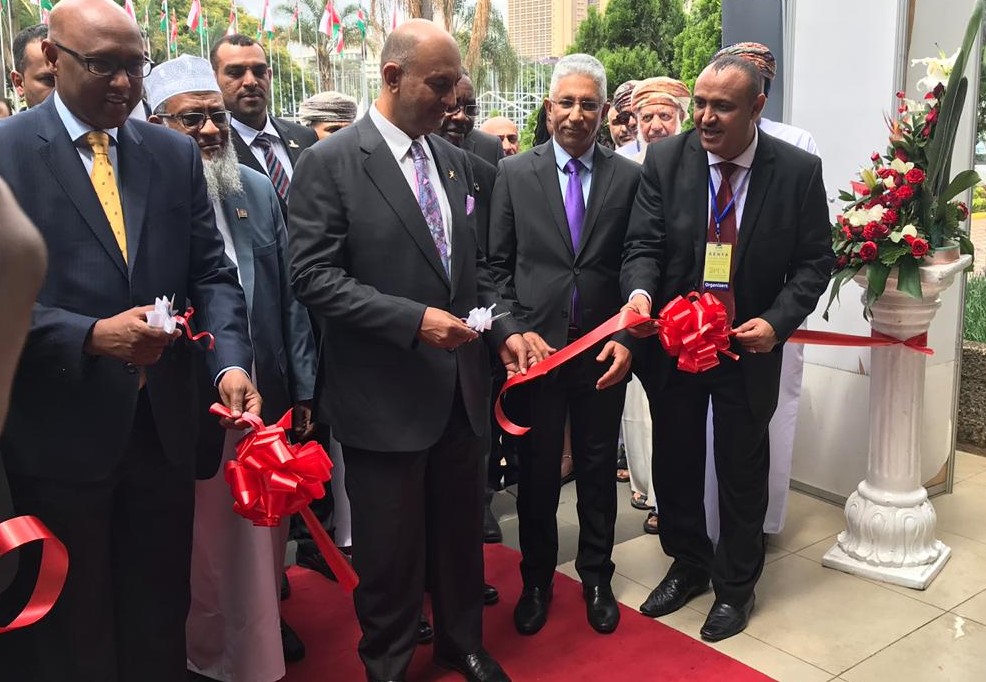
Kenyan government and the Sultanate of Oman are set to begin talks on setting up a Double Taxation Agreement (DTA) that will guide trade between the two countries. The agreement is expected to eliminate double taxation income arising from individual states and paid to residents of the other country.
Representatives from the two countries are set to meet and deliberate on the modalities of the DTA. Speaking during the opening ceremony of the Omani Products Exhibition in Nairobi, Oman’s Minister for Commerce and Industry H.E Dr Ali bin Masoud bin Ali al Sunaidy, said the two countries have enjoyed good relations in trade and having a DTA in place will see more growth in trade volumes. “Having a DTA in place will create a favorable environment for investment and trade. It will remove uncertainties on taxation arising by having two different authorities.”
On his part, the Cabinet Secretary for East Africa Community Adan Mohammed, reaffirmed Kenya’s commitment to further consolidate and advance bilateral economic cooperation between the two countries. “There is commitment from the two countries and soon we will set up a meeting that will foster the development of a DTA.” To date, Kenya has signed at least 21 DTA’s with different countries with the last one being that between Kenya and Japan.
During the meeting, Kenya and the Sultanate of the Oman, agreed to further work towards strengthening of business, trade and shipping links. Mutual collaborations in the field of manufacturing, trade, tourism, agriculture and housing were discussed during the two countries meeting at the exhibition. CS Mohammed also encouraged Omani businesses to explore the available opportunities that Kenya has to offer.
Over 100 Omani businesses are currently in Kenya participating in the Omani Product Exhibition. The exhibition is geared towards introducing Oman Industries to several companies and consumers in Kenya while highlighting the variety of Oman made products and services.

The trade fair seeks to link Kenyan exporters and importers to their counterparts from Oman
By Tullah Stephen
California based online home rental platform Airbnb, is taking over Africa’s tourism space at a fast pace. Since launching in Africa, Airbnb has managed to make over 130,000 listings available and recording over 3.5 million guest booking at listings on Airbnb across Africa. Half of the number recorded arrived in the last one year alone.
Airbnb lets people rent out their property or spare rooms to guests. At the start, the online home-sharing site allowed people to sleep on an airbed in random person’s living room for a low price. Airbnb’s model allows for low-value customers because since it does not require one to own property or employ operating staff. This was seen as a low-cost solution to a low-value customer.
The entry of disruptive ideas such as Airbnb is changing how people are viewing tourism in Africa. Previously, people associated tourism with certain landmarks, hotels, cultures, and festivals. But with Airbnb tourism is now viewed more inclusively with the idea of people and their homes. Rather than tourists booking motels and hotels, they now have access to people’s homes which offer a more personalized and intimate experience.
Once guests have booked, they together with their hosts, arrange when and where to meet. After which guests are shown around the property as they settle in. There is plenty of criteria to list for or search a property. Choices range from a shared room to an entire house. Guests have photos of the property, and the host with full map listing. For hosts who have a spare room to rent hosts on the other end, have chance to earn some cash. Airbnb takes 3 per cent commission of every booking from hosts, and between 6 per cent and 12 per cent from guests.
According to a report by Airbnb titled Overview of the Airbnb Community in Africa released in 2017 local households earned about USD2 .1 million. Hosts in South Africa and Morocco, two of the most popular destinations averaging about USD 1,000 annually, have earned over USD400 million in income. Hosts on Airbnb in Kenya have been welcoming guests into their homes since 2012. Airbnb reports that 46 per cent of Kenyan host income is earned by women hosts. Collective earnings from hosting on Airbnb for Kenyans in 2017 increased by 106 per cent compared to the previous year.
Kenya has about 5,900 active listings on Airbnb with USD970 annual earnings for a typical host. In 2017, about USD3.9 million was earned by Kenyans as income. According to a recent report by Airbnb, Nigeria registered 213 per cent growth on guest arrivals, Rwanda 73 per cent, Ghana 141 per cent, Kenya 68 percent while Mozambique and South Africa recorded 136 and 65 per cent as at July 2018.
However, such disruptive technologies face hurdles from sectors they enter. For Airbnb the challenge has been mainly on the regulatory front. Hotel and resort owners have been up in arms at the lack of regulation applied to Airbnb as well as ways it can manipulate the accommodation market in times of high demand. Some argue that Airbnb has encouraged private home-owners to rent out rooms in competition with established hospitality businesses.
Key argument has been the fact that registered operators have to comply with regulations, private operators such as those on Airbnb are getting away without paying tax or levies. In response to that, governments in Africa has been seen to tighten the noose for private operators. Namibian government has already ordered for any accommodation establishment with two or more bedrooms to register with the tourism board. While Tanzania, in September, the government of Tanzania gave a 50 day window for operators like those signed up with Airbnb, to register or face arrest.
Other sticking points for Airbnb in Africa include the lack of confidence in destinations and hosts, and safety concerns given the platform’s regulatory grey areas. “There’s always the danger with products offered online. Things can sometimes not be as they seem to be in flesh. However there are reviews which can also help guests make their decision,” says Lisa Vierri Airbnb hosts from Kenya.
Beyond South Africa, the rest of the continent has generally been slower to take off – although Airbnb’s CEO and co-founder, Brian Chesky, who was quoted by QZ magazine saying the company’s management remains confident over its potential. According to Chris Lehane, Airbnb Global Head of Public Policy and Public Affairs, among the things that make Airbnb a game changer is that it directly empowers people at the grass roots. Chris was speaking during the Airbnb Africa Travel Summit in Cape Town South Africa in September.

Total Kenya Plc launched the second edition of Startupper of the Year Challenge that seeks to promote creative ideas and entrepreneurship among young citizens.

Truck and bus manufacturer Isuzu East Africa on Monday launched the first Isuzu Service Center in Africa at its assembly plant in Nairobi’s Industrial Area, as it marked off the international customer service week.

Through this partnership, MTN MoMo customers will use a virtual card to shop or make payments at the vast network of global outlets accepting Mastercard payments
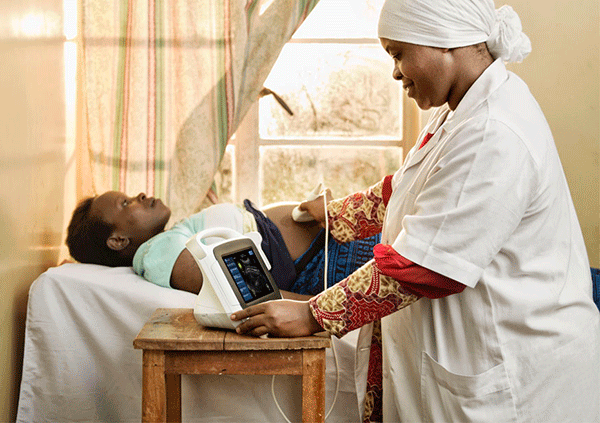
In addition to the equipment and training, GE Healthcare will provide monitoring and evaluation (M&E) advisory support to the county