Ten years ago, a novel experiment began in the green hills of the Upper Tana watershed — the idea that investing in the landscape upstream could secure the water supply of a sprawling, thirsty metropolis downstream. A decade on, the numbers tell a striking story.
More than 27 million additional litres of water now flow into Nairobi every dry-season day as a direct result of the programme. Turbidity — the murkiness that drives up treatment costs and threatens public health — has fallen by 41 percent, saving the city’s utilities 1.2 million US dollars in water-treatment expenses. Over 470,000 acres of farmland and forest, and 980 kilometres of river, are under improved sustainable management.
These are the results of the Upper Tana-Nairobi Water Fund Trust — Africa’s first water fund, and now a model being studied and replicated across the continent.
Protecting Water at the Source
The Upper Tana River supplies roughly 95 percent of the water used by Nairobi’s 4.8 million residents and supports an additional 5 million people living in the broader basin. Any degradation upstream is felt, swiftly and directly, in the taps of one of East Africa’s largest urban centres.
The Nature Conservancy launched the water fund in 2015 as the first initiative of its kind on the African continent. The premise was elegantly simple: rather than building ever-larger treatment infrastructure to cope with dirty water, pay farmers and communities in the catchment to manage their land in ways that keep the water clean and the rivers flowing. It has since become an independent, registered public charitable trust with its own governance structure and science-based decision-making.
Farmers at the Heart of the Solution
The transformation has not happened in boardrooms alone. Over 260,000 farmers have adopted climate-resilient land management practices in the catchment. Some 17,000 water pans — small excavated reservoirs that capture rain before it washes away topsoil — now harvest more than 2 billion litres of rainwater every year, reducing both erosion and pressure on the river system.
The programme has also planted 5.9 million trees, created more than 22,000 green jobs and generated 118 million US dollars in additional income for farming households through fruit, nut and livestock feed value chains. The approach reframes watershed conservation not as a sacrifice asked of rural communities, but as an economic opportunity.
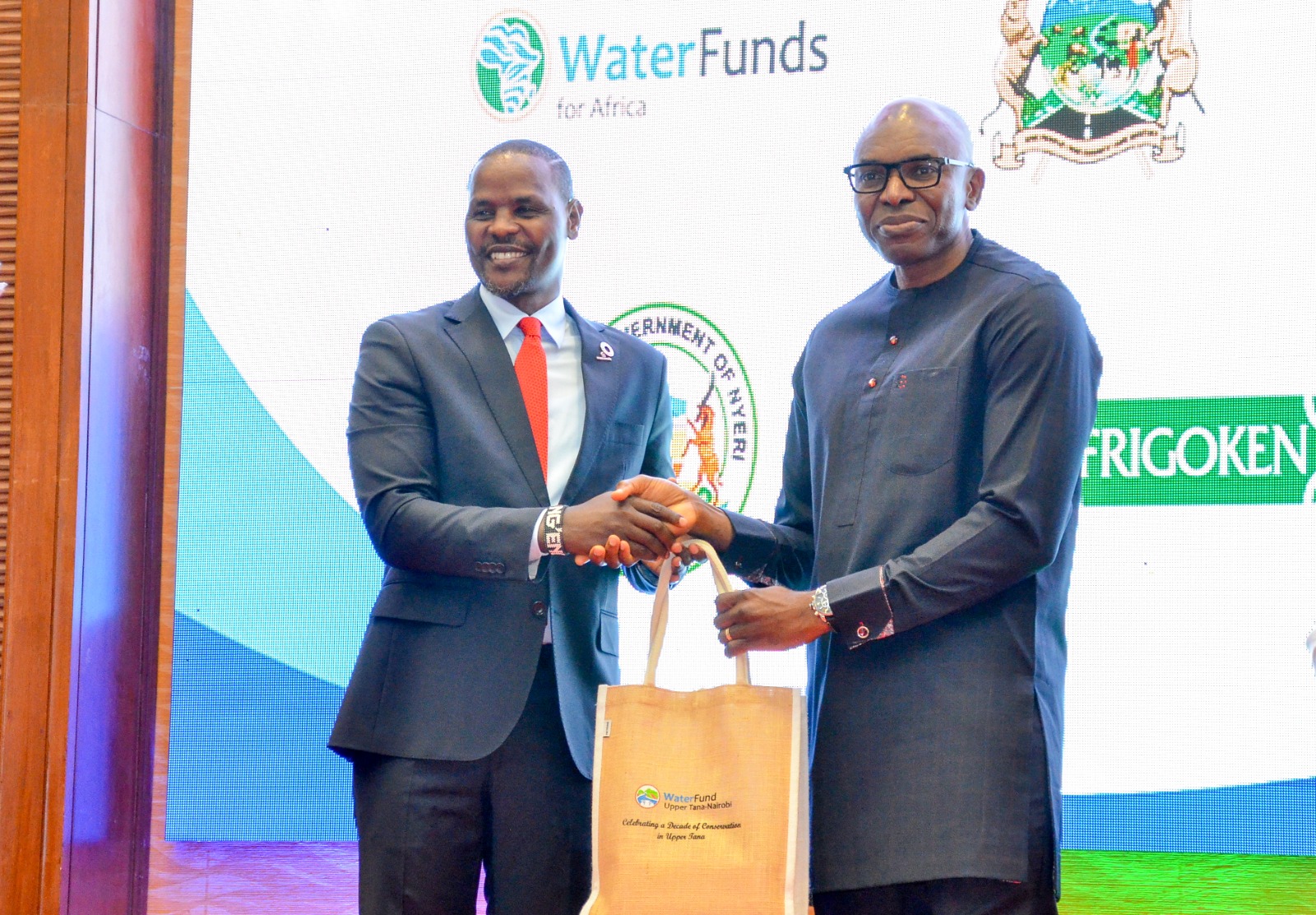
As Trustee President Eddy Njoroge put it at the anniversary event: “Our biggest lesson from the last ten years has been that it is more cost-effective to address these challenges upstream.”
A Model Ready to Scale
The water fund concept was first pioneered in Quito, Ecuador in 2000. It has now been replicated in more than 30 cities worldwide, including 16 in Africa. In Kenya alone, four additional water funds have since been established — in Eldoret-Iten, the River Yala-Nyando basin, the Upper Tana Mid-Galana area and the Jumuiya region.
Kenya’s Principal Secretary for Environment and Climate Change, Dr. Eng. Festus K. Ng’eno, praised the fund as one of the country’s strongest examples of a public-private partnership for watershed restoration, calling on development partners, climate funds and private sector actors to scale investment and replicate the model across Kenya’s water towers.
Partners at the anniversary event called for increased sustainable financing, stronger private-sector participation and deeper community engagement to carry the model further. Nairobi’s water security, they argued, is not just a local story — it is a proof of concept for a continent under growing climate pressure.
