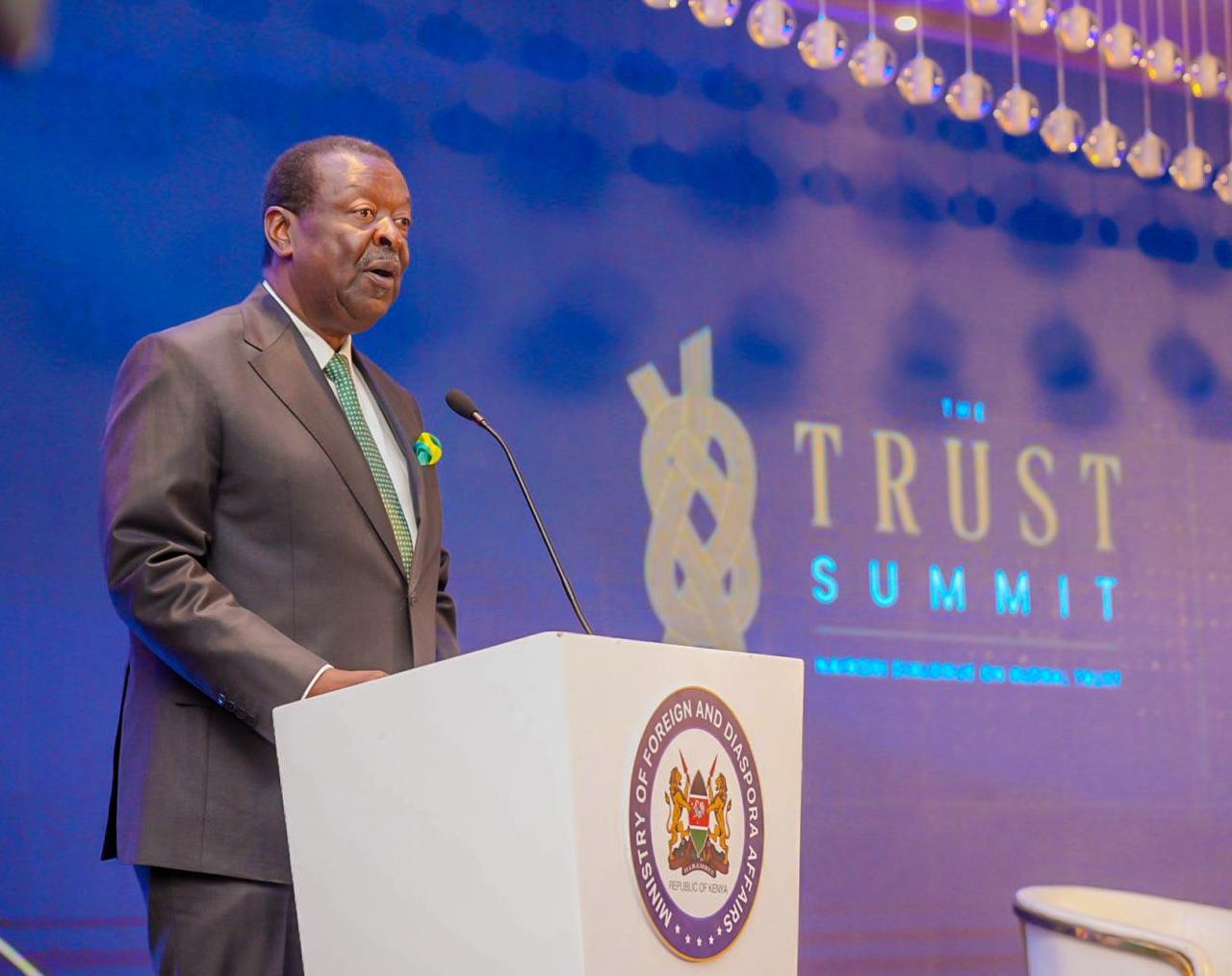
Kenya’s Prime Cabinet Secretary Musalia Mudavadi has called for stronger accountability and inclusive governance, warning that public trust in institutions cannot be sustained without integrity, fairness and demonstrable results.
Speaking on the second day of the Global Trust Summit in Nairobi, Mudavadi said declining public confidence threatened institutional stability, economic prosperity and the ability of societies to address shared challenges.
“When a society loses the trust of its people, it risks losing the very foundation upon which its institutions, prosperity and common future depend,” he said.
Mudavadi cautioned that public confidence in political leaders should not be mistaken for effective accountability. Citing an Afrobarometer working paper based on surveys across 37 African countries, he noted that greater trust in presidents and ruling parties was associated with weaker public support for parliamentary oversight, media scrutiny and citizens’ ability to hold governments accountable.
He argued that trust and accountability should reinforce each other, with institutions earning public confidence through transparent conduct rather than expecting unquestioning loyalty.
“The strongest institutions are not those that ask people to trust them blindly, but those that inspire confidence through their conduct while remaining transparent, answerable and open to scrutiny,” he said.
The Prime Cabinet Secretary also raised concerns about declining public confidence in science. Referring to the Wellcome Global Monitor 2026, he said the proportion of people who believed most people in their country benefited from science fell from 42 per cent in 2018 to 37 per cent in 2025.
He said scientific institutions needed to demonstrate how research and innovation improved people’s lives, while ensuring that evidence was communicated openly and that healthcare and scientific advances were accessible fairly.
Mudavadi further described trust as an economic asset that facilitates business relationships and cooperation. Although contracts and legal safeguards remain important, he argued that commercial relationships also depend on integrity and a reputation for honouring commitments.
“Trust is also economic infrastructure,” he said, warning against business practices that prioritise profits and transactions at the expense of ethical conduct.
On international governance, Mudavadi called for institutions to become more representative, singling out Africa’s lack of a permanent seat on the United Nations Security Council as a challenge to global legitimacy.
He said African countries should participate directly in decisions affecting their security and future, consistent with the African Union’s Common African Position.
The summit also heard from Tanzania’s Deputy Minister for Foreign Affairs and East African Cooperation, James Millya, who outlined progress in removing trade barriers between Kenya and Tanzania.
Millya said the two countries had identified 68 non-tariff barriers, resolved 54 and retained 14. He noted that bilateral trade had declined from approximately US$950 million in 2024 to US$860 million in 2025, underscoring the need to translate agreements into practical improvements for businesses.
The Global Trust Summit, running in Nairobi from October 21 to 23, brings together public officials and other stakeholders to discuss the role of trust in governance, economic inclusion, social cohesion and international cooperation.
