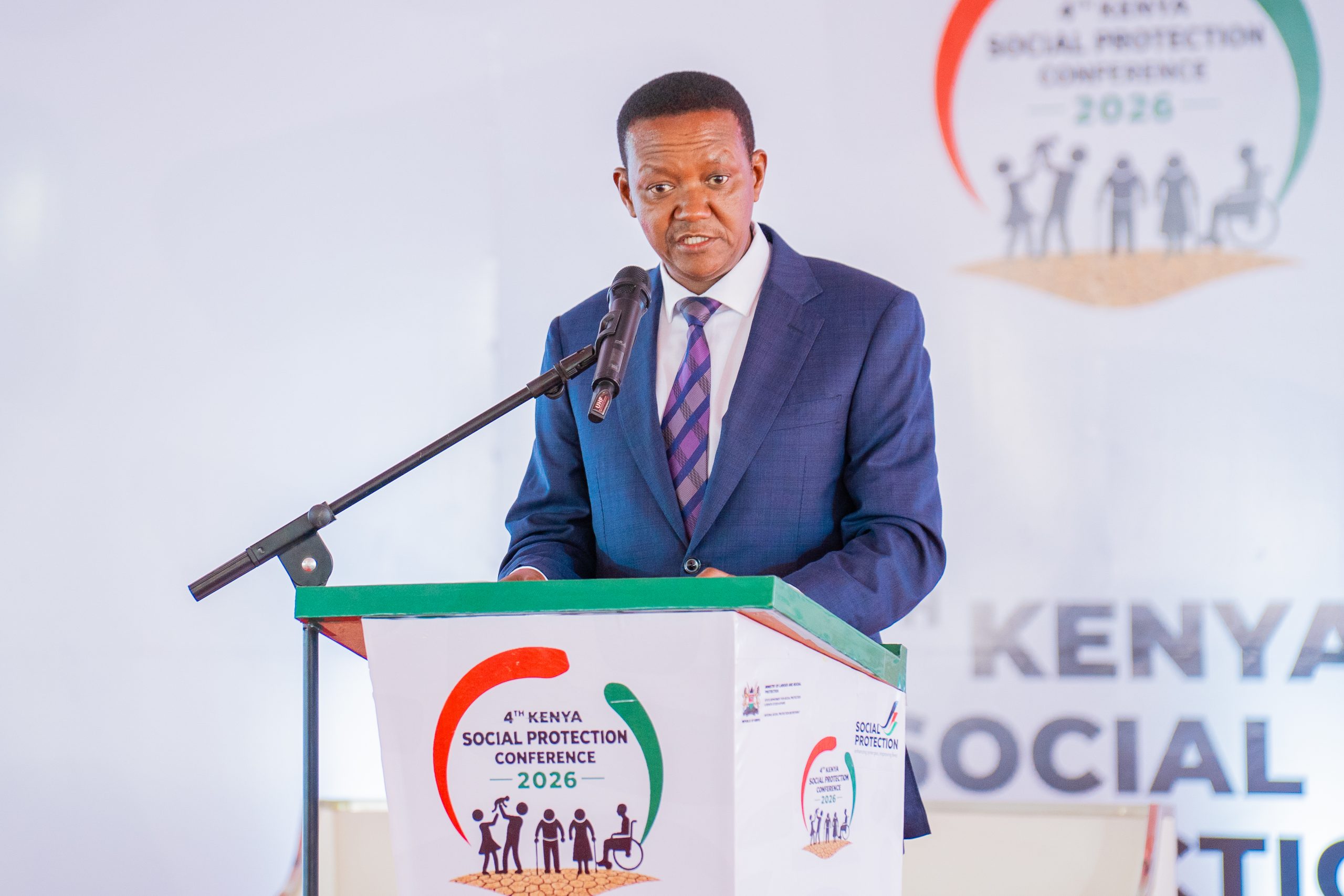
The Government has reaffirmed its commitment to strengthening Kenya’s social protection system, announcing plans to establish and capitalise a Social Protection Fund and expand the Inua Jamii programme to reach 2.5 million households.
Cabinet Secretary for Labour and Social Protection, Hon. (Dr.) Alfred Mutua, made the commitments at the official opening of the 4th Kenya Social Protection Conference 2026 at the Kenya School of Government. The conference brings together government, county governments, development partners, researchers, civil society and the private sector. Its theme is “Re-imagining Social Protection in an Evolving Socio-Economic Landscape and Climate Change: Strengthening Adaptive, Transformative and Sustainable Social Protection Systems for Inclusive Development in Kenya.”
Inua Jamii grows to 1.7 million beneficiaries
The Government now provides more than KSh3.5 billion every month to vulnerable Kenyans. Inua Jamii has grown from 1.2 million to 1.7 million beneficiaries, adding 500,000 people, and the Government says it will keep expanding towards the 2.5 million household target while protecting cash transfer allocations. Payments have also moved from commercial banks to mobile money, particularly M-PESA, bringing them closer to older persons, persons with disabilities and other beneficiaries.
Between FY2022/23 and FY2025/26, KSh7.947 billion was allocated to programmes run through the National Council for Persons with Disabilities, of which KSh7.277 billion was disbursed. More than 330,000 persons with disabilities were newly registered, and the Cash Transfer Programme for Persons with Severe Disabilities now reaches 63,960 people, up from 30,000.
From cash support to livelihoods
Addressing delegates, CS Mutua said: “Ours is a Ministry built around a single duty, to safeguard the Kenyan who has no cushion of their own, the older person, the orphaned child, the person with severe disability, the household struck by drought or flood or any other shock that may come.”
He argued that cash transfers alone cannot build lasting resilience, and that labour must carry social protection’s purpose into permanence. He pointed to a labour market under strain: the Economic Survey 2026 shows 882,100 new jobs were created in 2025, more than 80 per cent of them informal, with 18.1 million Kenyans earning a living outside formal employment.
In response, the Ministry has developed a strategy to extend social protection coverage to the rural and informal economy. The CS has also directed the National Social Security Fund and the Retirement Benefits Authority to speed up simple, portable savings products for boda boda riders, mama mbogas and jua kali artisans.
On wages, he said he has signed legal notices formalising a 12 per cent general wage increase and a 15 per cent increase for agricultural workers, which are now before the Attorney General for gazettement. Nationwide recruitment under the Kazi Majuu programme has resumed, and talks continue on portability of social security benefits for Kenyans working abroad.
The CS also highlighted the NYOTA programme, through which KSh3.05 billion in business start-up capital was disbursed to 122,203 young Kenyans on 10 July 2026. “NYOTA is not a cash transfer. It is training, mentorship and capital, deliberately designed to graduate our young people from vulnerability into enterprise, and it stands as the clearest example I can offer this Conference of labour serving as the engine that carries social protection’s promise forward.”
The Kenya Social and Economic Inclusion Project (KSEIP) was also cited as a pathway to economic inclusion. It supports early childhood nutrition, addresses adolescent vulnerabilities and improves social protection registries for faster responses to shocks. National stunting among children under five has fallen from 26 per cent in 2014 to 18.4 per cent.
School meals programme to be rolled out
The Government has committed to progressively establishing a National School Meals Programme covering lower primary, upper primary and junior secondary learners across all 47 counties. The Ministry of Education, working with the Ministry of Labour and Social Protection, the National Treasury and other stakeholders, will develop the policy, financing, governance and implementation framework for a phased rollout starting in the first school term of 2027.
A stronger policy framework
The conference comes as Kenya builds up its legal and policy framework for social protection. Recent developments include the Social Protection Policy 2023, Persons with Disabilities National Policy 2024, Social Protection Act 2025, Persons with Disabilities Act 2025 and Social Protection Regulations 2026. Discussions will focus on shock-responsive protection, inclusive coverage, digital transformation and data, sustainable financing, livelihoods, and institutional coordination.
Looking ahead to Kenya’s development beyond Vision 2030 and towards 2060, CS Mutua said: “no vision for our country’s future can be credible unless it answers, plainly, how our people will work and how they will be protected while they do.”
He thanked development partners including the ILO, World Bank, UNICEF, UNHCR and the World Food Programme, and called for stronger collaboration between national and county governments, the private sector and civil society so that vulnerable Kenyans are not left behind.
