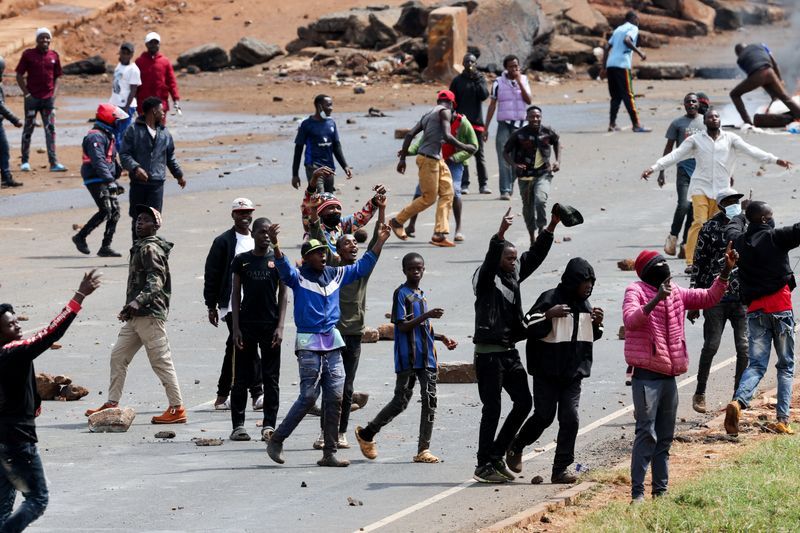
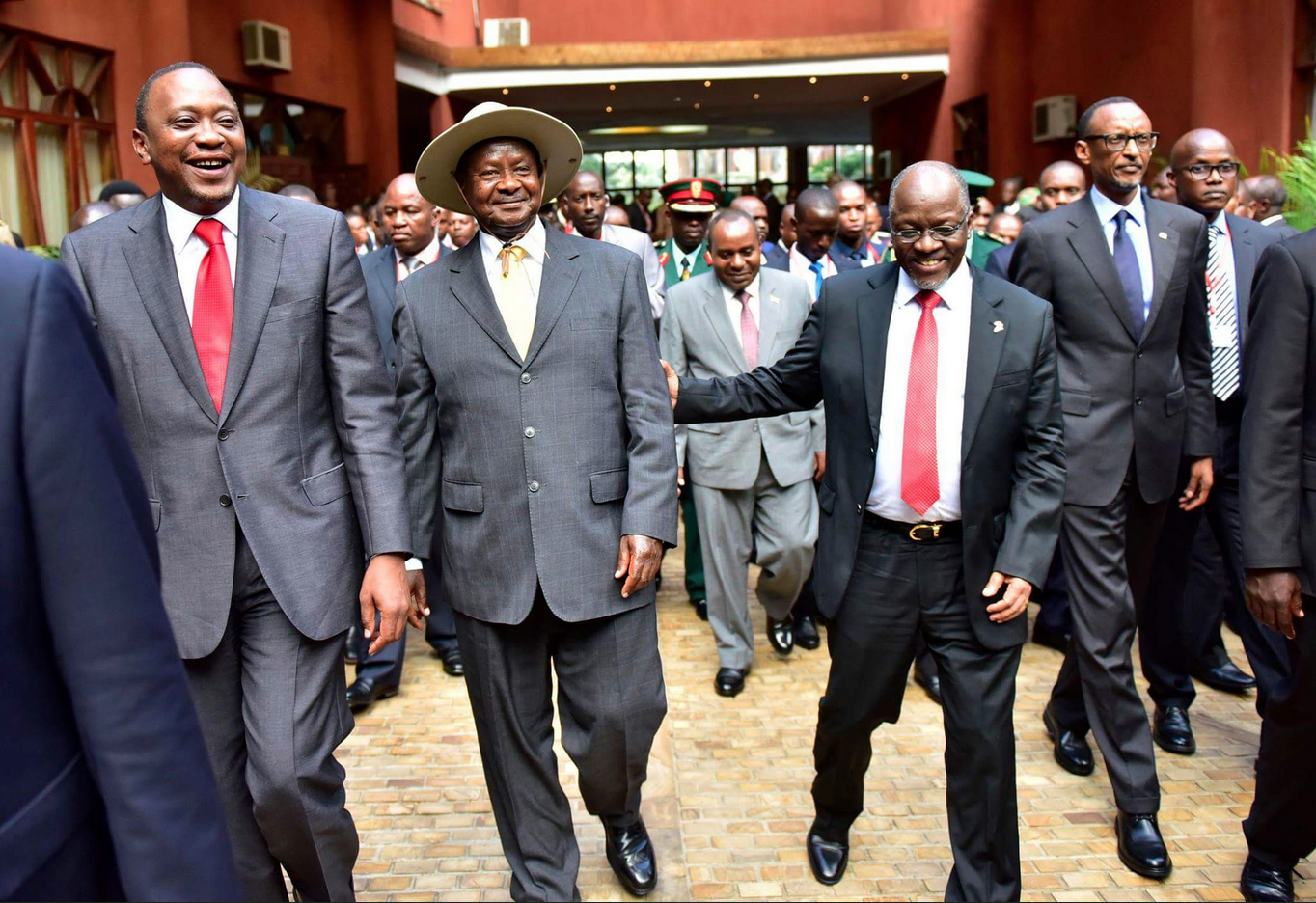
The recently held elections in Tanzania have ignited widespread protests, as demonstrators voice their disapproval of the government’s decision to bar prominent opposition leaders from vying for the presidency and subsequently charging them with treason— a crime carrying a potential death penalty. These protests, particularly felt in Dar es Salaam and other major Tanzanian cities, have escalated into violence. Scenes of rage where protesters are tearing down the posters of President Suluhu, lighting bonfires and targeting private properties, littered the social media.
In response to this unrest, the Tanzanian government shut down the internet and imposed a dusk to dawn curfew. Critics argue that these measures represent a blatant violation of democratic principles, including freedom of expression, access to information, and the right to vote. These events, unfolding under the watch of the international community, are further wounding the nation’s already struggling economy.
The government’s suppression of dissent through internet shutdowns and mistreatment of opposition leaders is perceived as deterrence to foreign investment and an incitement to violence among citizens. This, in turn, has led to the looting and destruction businesses and damage to infrastructure—all critical contributors to national economic growth. Other deliberate actions, such as media gagging and various unprecedented moves by the Tanzanian government, are seen as undermining socio-economic development, which relies on national integration fostered by unity and common values.
Like Tanzania, in 2024, Kenya experienced significant nationwide protests marred by abductions and extrajudicial killings, resulting in substantial negative economic impacts. Earlier this year, Uganda witnessed widespread protests and violations of fundamental rights following the abduction of an opposition leader, Kizza Besigye, in Nairobi and his subsequent arraignment in a military court in Uganda. Since then, a series of protests have erupted concerning taxation introduced on small businesses and the acquisition of business permits. These events led to the establishment of parliamentary committees to address public grievances. A section of international lawyers was permitted to observe the court-martial proceedings.
One thing is certain in all these regrettable circumstances. A threat to democratic rights is akin to striking at the heart of a nation. It invites instability, shaking the very foundations upon which a nation is built, most notably its economy. It is imperative that the East Africa Community intervenes to assist one of its own through dialogue and counsel on safeguarding democratic rights and fundamental freedoms. These elements are key players in national growth, socio-economic flourishing, and integration.
Kenya
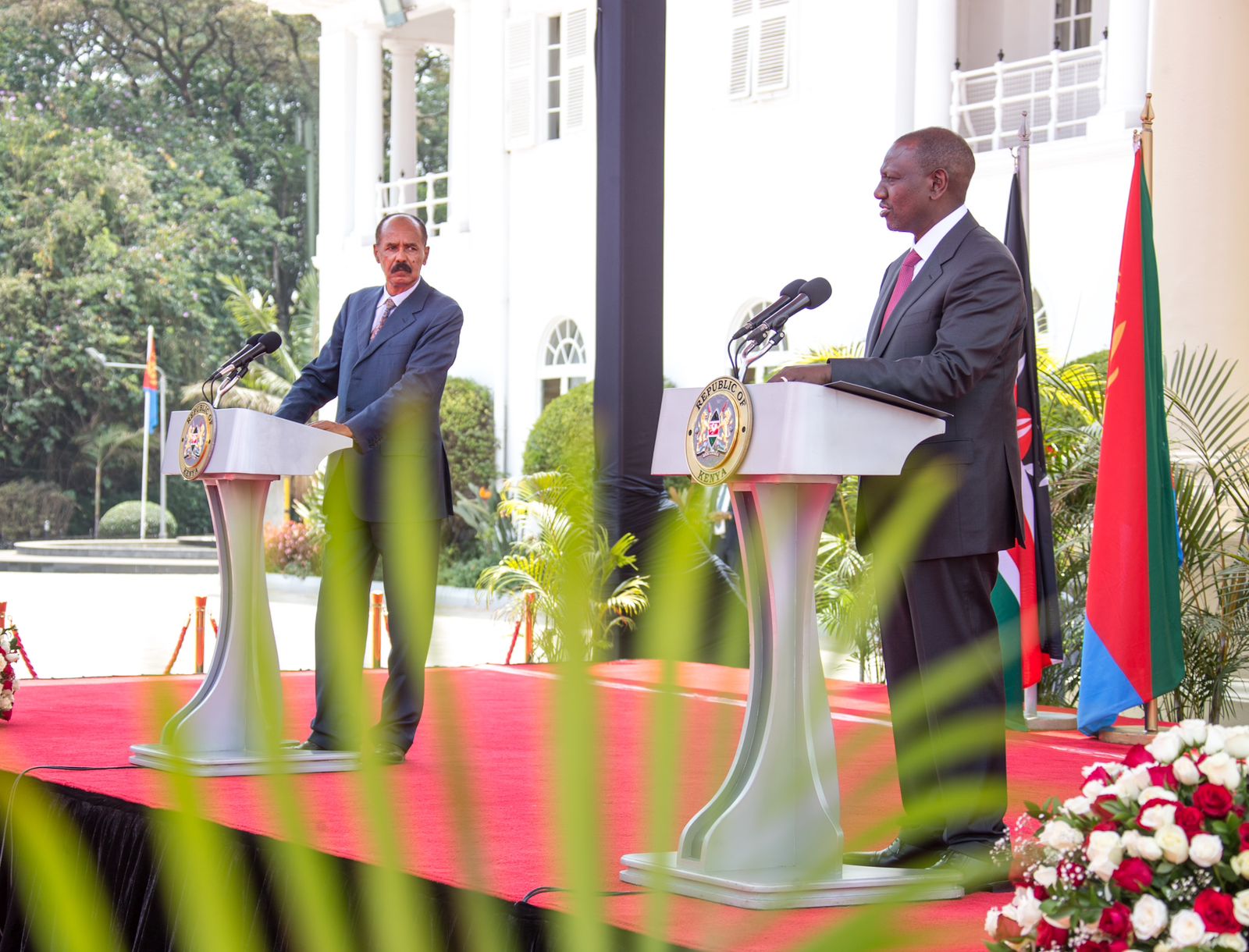
Kenya and Eritrea have agreed to scrap visa requirements for their citizens permanently to ease the relations of the countries.
The move, they explained, will catalyze the country’s economic transformation for both the parties involved hereby.
The announcement was made on Thursday at State House, Nairobi when President Ruto held bilateral talks with his Eritrean counterpart, Isaias Afwerki.
“We must have a regime free of barriers to further integration, strengthen connectivity and enhance regional trade,” said President Ruto.
The two countries agreed that there exists enormous trade and investment potential between them that calls for structured collaboration.
We must have a regime that is free of barriers to further integration, strengthen connectivity and enhance regional trade
They cited renewable energy, water management, agriculture, transport, security, tourism, sports mining, the blue economy, and education.
As of 2020, the trade volume between Kenya and Eritrea stood at Sh73.4 million as compared with Sh257 million in 2015.
President Ruto said the relatively low figures were an indicator that the opportunity in trade is “enormous”.
“With the operationalization of the African Continental Free Trade Area, we must cooperate in mapping out mutually beneficial strands of economic opportunities for our countries.”
He hailed Eritrea’s commitment to peace and stability in the region.
This, President Ruto noted, has paved the way for cooperation for regional peace and development.
President Afwerki said Eritrea was committed to taking measures that facilitate the deepening of economic, social, and cultural relations with Kenya.
“We will keep promoting joint investment and work together towards enhancing sustainable peace and security,” he said during their joint media briefing.
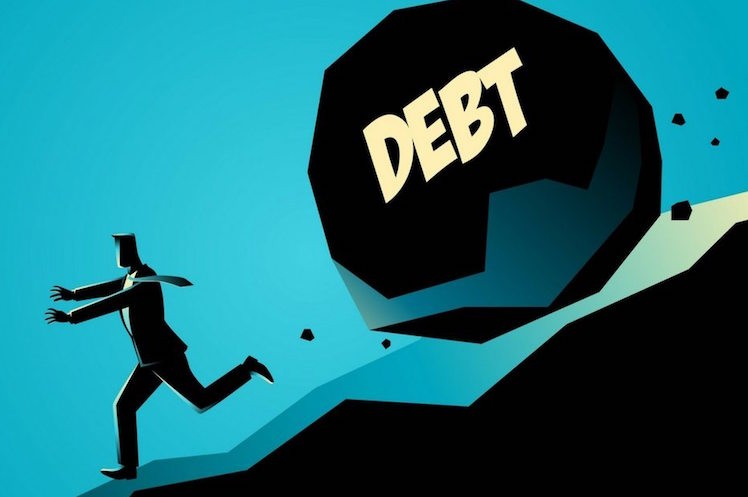
In order to finance major infrastructural and other priority projects, the Kenyan government has resorted to sustain its borrowing trends, increasing the public stock debt rate to 16% for since June 2013 to reach Kshs. 5.4 trillion as at the end of March, 2019.
Economic estimates indicate that the country debt have more than quadrupled over the past 7 years and as a result, the stock of debt has had an annualized growth. With the continued demand for new debt issuance each annual year, the national debt burden is expected to increase to Kshs. 6.2trillion by end of June 2020.
A report released by the parliamentary budget committee shows that Kenyans will have to buckle up as the government put in stringent measures to cut cost to service its lenders loans.
The report says,” with the inability of adhere to the fiscal consolidation path, the trend of debt accumulation is likely to continue rising and the ratio of debt to GDP is likely to be contained by GDP growth rather than debt fiscal policy designed to contain the expenditures.”
“Effect of debt servicing on revenue, are likely to result in year fiscal strain, necessitating dependence on domestic short-term debt borrowing, worsening the debt distress level,” the report adds.
The report further raises concerns over the appreciating interest rates charged by the lenders. The country owes trillions to the Asian economies with Exim Bank of China (Kshs. 37.8 billion) taking the lead. Others are TDB Syndicated (Kshs. 17.1 billion), International Sovereign Bond – 2018 (Kshs. 16.6 billion).
To escape, the borrowing trend, the budget committee report advocates for limited spending from the government and enhancing revenue collection. Financial analysts advise on measures that the government should undertake to realize Kenyans off this burdensome gruel.
“Efficiency gains, not additional funding, is the key to effective implementation of government projects without further accumulation of debt. However, expenditure pressures, particularly due to implementation of key government projects have in the past been viewed as a bottleneck in the government’s quest for lower spending. Efficiency gains entail effective utilization of public resources such that the country is able to achieve more with fewer resources,” says a team of analysts in the budget committee.
Public debt stands at 62 per cent of gross domestic product and could hit 70 per cent of GDP in the near future if the government continues to borrow at the current rate, ultimately meaning that Kenya would have crossed the threshold to debt distress.
“It is important that future debt management adopt measures to ensure debt is not accelerating. One of the measures is to ensure that in the planned fiscal consolidation the government must stick to a path that seeks to reduce debt from 62 per cent of GDP towards 55 per cent in the medium term,” said Peter Chacha, World Bank senior economist.
The Central Bank of Kenya (CBK) lists the country debt to World Bank at Ksh5.4 trillion as per March 2019.This figures are equivalent to 56.4 percent of the GDP. The global monetary body International Monetary Fund (IMF) recommends that ratios of public debt to GDP should not exceed 40 percent for developing countries. Kenya economists says Kenya could however surpass this limits if its borrowing streak continues.
To be fair, this level of debt is comparable to that of other developing economies. For example, South Africa’s ratio of public debt to GDP was 53.1% in 2017 (2008: 27.8%). Nigeria’s was 21.3% in 2017 (2008: 7.3%). Brazil, India and China all have ratios over 40%. However, the economies of these countries are several times larger than Kenya’s.
The ongoing infrastructural developments have majorly been funded by foreign banking and global economies. The parliamentary budget committee encourages that public investment participation should be practiced to cut in debt. Construction and improvement of the road and rail network including expansion of existing roads (highways and critical access links) especially in the cities and urban areas remains a key priority of the government. These public investments are expected to greatly facilitate trade, private sector investment and movement of people within and in the region. However, the accumulation of pending bills remains a significant downside risk to timely actualization of infrastructure investments and their impact on the economy
“Public debt servicing costs will decline by 20% to Kshs. 696.6 billion, as a result of reduction of expenses to be incurred on domestic and external debt redemption by 44% and 48%,” the report by the committee urges.
CBK unveils the new Currency during the Madaraka Celebrations
The new generation bank notes are now in circulation.
During Madaraka Day celebrations on Saturday, CBK governor Patrick Njoroge announced the notes were issued on Friday, May 31 via a Gazette notice.
The new notes are now legal tender.
Njoroge said to curb illicit finance, all old Sh1,000 series notes have been withdrawn by a Gazette notice dated May 31 and Kenyans have until October 1 to exchange the older notes for newer ones.
CBK Governor said the new notes will serve as a means of passing knowledge and passing culture and promoting Kenya’s global uniqueness.
All notes bear the image of KICC.
They also have each of the Big Five animals.
Each note has a unique theme.
Sh50 is for green energy, Sh100 for agriculture, Sh200 social services, Sh500 for tourism and Sh1,000 for governance.
Following the passing of the 2010 Constitution, the CBK was mandated to spearhead the production and roll out of the new currency notes.
The Constitution prohibits the use of a person’s portrait on currencies meaning the upgrade is expected to have new features.
Notes currently in circulation have the images of first President Jomo Kenyatta and his successor Daniel Arap Moi.
The new-look notes are fashioned to enable the visually-impaired to use them.
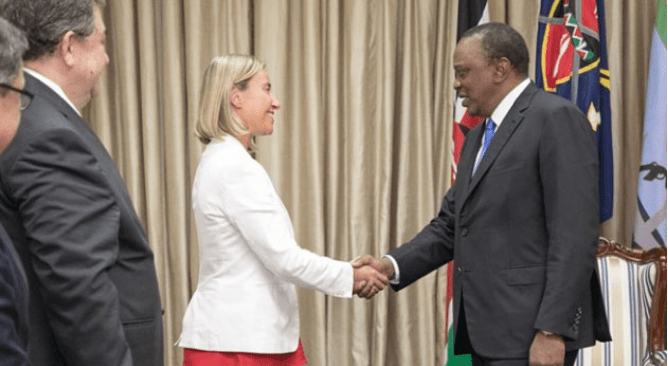
The European Union has opened a new embassy in Kenya which is the world’s second mission serving as a gateway to Africa and as a regional hub.
The embassy was unveiled by EU High Representative Foreign Affairs and Security Policy, Federica Mogherini, who held a joint news conference with Foreign Affairs CS Monica Juma.
“We see Kenya as not only a gateway to the region and Africa but also as an important hub, our investments both economically and politically, in terms of security cooperation is key for the European Union, and we value Kenya’s partnership enormously,” Mogherini added.
Kenya’s for Foreign Affairs Monica Juma also revealed that Kenya had asked EU to support its bid for a non-permanent membership of the United Nations Security Council (UNSC) for the 2021/22 term.
“We’ve had discussions around regional peace and security matters as well as integration. We’ve discussion cooperation in Somalia, South Sudan DR Congo as well as my request for EU’s support for Kenya’s bid for UNSC,”
Uganda’s Allen Namagembe typifies the emerging East Africa. On a hot afternoon, she is travelling on a Rwandan airline to catch a doctor’s appointment at a Kenyan hospital. It is very much a realization of the vision the East African Community’s (EAC) founders had: closer integration and the elimination of barriers for the benefit of citizens.
But Namagembe is perturbed that, having misplaced her yellow fever vaccination certificate, airport officials had insisted on her acquiring another before they could let her through. This even as the stamps that dot the pages of her passport show the history of this same routine itinerary, proof that her vaccination is in order.
She is an epidemiologist who researches clinical skills, and Namagembe is lucky to be allowed to proceed where many are blocked. At Uganda’s Entebbe airport, travelers regularly miss flights as airport officials shove them back to the end of queues for lack of vaccination certificates. A well-meaning screening policy has morphed into something of a non-tariff barrier to trade in services, in a region rated as the most advanced economic bloc on the continent.
Among eight regional economic organisations recognized by the African Union, EAC stands tall in terms of integration above the Arab Maghreb Union; the Community of Sahel-Saharan States; the Common Market for Eastern and Southern Africa; the Economic Community of Central African States; the Economic Community of West African States (ECOWAS); the Intergovernmental Authority on Development (IGAD); and the Southern African Development Community.
Cracks showing
The six-member EAC – having established a free trade area, a customs union, a common market, partially attained free movement of people and looking to establish a monetary union by 2024 – is an especially high-performer on two elements, trade and productive integration, according to the Geneva-based International Trade Centre. On the other hand, IGAD and ECOWAS outperform on infrastructure and free movement of people, respectively. The EAC also boasts of the fastest-growing intra-regional payment systems on the continent, data from payments firm SWIFT shows. But trade among member states is estimated at 20%, much lower compared to intra-regional trade in the European Union (EU) – at 67%.
As it approaches 20 years since its formation this November, cracks are starting to show within the EAC. A mixture of rivalry and diverging national interests are driving the creation of non-tariff barriers, which curb progress.
This is disappointing for Kiprono Kittony, the chairman of the Kenya National Chamber of Commerce and Industry, the most powerful business lobby in the region’s largest economy.
“We still have quite a few non-tariff barriers that are in place,” Kittony tells The Africa Report. “I see a weakness in terms of the bureaucratic capacity to follow up on the resolutions of the summit,” he adds, referring to the annual meetings where heads of state assess progress and issue directives. The last one took place in February of this year amidst tensions related to Burundi, which is in the middle of a grinding conflict related to President Pierre Nkurunziza’s strong grip on power (see page 80).
“At the high level of the summit, you see a lot of goodwill towards the customs union. But when it comes to implementation, you still find – even up to the summit – a lot of obstacles, that the same themes keep recurring,” Kittony argues. “I would actually recommend that we need to have more implementation committees, both at the high level of the summit, and even at the lower level of the bureaucracies.”
But regional rivalries loom behind the barriers to trade. Domination by Kenya is a real fear of the smaller economies, and Kittony acknowledges the need for some concessions: “You see the economies are very different in scale. […] There should be some concessions given to the landlocked countries by the larger economies, like Kenya and Tanzania, that will benefit say Rwanda and Burundi. That will create a feeling that it is a level playing field for everybody.”
Similar problems
Kenyan companies are continuing their expansion into the region. Many investors are putting money into Kenyan companies that have succeeded in fixing problems in Kenya “because you tend to have very similar problems across the region,” says Konstantin Makarov of StratLink, a Nairobi-based advisory company. “We are also big believers in the food value chain that starts with primary farming and ends with restaurants, and everything in between.”
Should current issues, like the failure to implement the customs union, persist, there are fears the remaining parts of East Africa’s integration agenda will get derailed. “The customs union came into force in 2005 to facilitate the establishment of the common external tariff so that we can have the removal of the intra-regional issues. But up to now we must appreciate that the customs union is not fully operational,” says Peter Mathuki, acting chief executive of a regional business lobby, the East African Business Council.
“Without a fully fledged customs union, the common markets protocol – which is the second level of integration – will not work,” Mathuki adds. “A common market must work fully to allow monetary union.”
Indeed, this trend feeds into an emerging pattern of problems. In 2005, the EAC commenced negotiations with the EU on the Economic Partnership Agreement. Having failed to reach consensus through 14 years of talks, the EAC leaders at their February summit decided it was time each country engaged the EU on its own.
‘Waiting and observing’
Mathuki says things would have turned out different if the region’s private sector was not isolated by politicians. “All along, we have been observers. We don’t want to be observers any more. We want to be partners in sorting out issues because non-tariff barriers mostly affect the private sector,” he explains. “Once you leave it to the government alone, it will be the same story as for the last many years. But once we now become part of it, we will be offering solutions that are practical but not just waiting and observing.”
For all its weaknesses, the EAC has many supporters. One of them is Ian Clarke, a Ugandan of Irish origin who first arrived in Uganda as a missionary doctor in 1987. He went into business in 1994, setting up a private clinic, the International Medical Centre (Group). By 2015, when Clarke sold about 91% of his holding to Ciel Healthcare of Mauritius, it had grown into a healthcare group spanning 22 clinics, Uganda’s largest private hospital, a medical insurer and a health sciences university. Now Clarke’s holdings include the health sciences university, elementary education services, agriculture, a sterilization start-up and a hotel on the Tanzanian island of Zanzibar.
“I do feel very much that I am an East African, and there are good signs,” says Clarke, who sits on the board of the regional private healthcare lobby, East Africa Healthcare Federation. “But it’s not as if all the barriers have gone down. There are still a lot of issues.
“What has happened in the last five to eight years, you get local players like myself who have started a company, a hospital or whatever, and then you get the private equity guys to come in and they acquire your hospital in this country and then a hospital in another country,” Clarke says. “They are looking to see if they can build up brands, if they can build up chains. That’s what’s going on. It’s early stages yet, but it’s in process. How successful it will be depends on the economy.”
New members
Kittony, a media tycoon back in Kenya, says he hopes the EAC will lead the continent. “For me, I think we should really do everything possible to make it a success. It’s the most successful bloc we have, and it should be the paradigm for the African economic blocs as they step forward towards the Continental Free Trade Area,” he argues.
Fortunately for the EAC, it is not short of courtiers that want to join it. Somalia has submitted an application to join and awaits a verification exercise. The Democratic Republic of Congo’s new leader, Félix Tshisekedi, has also expressed interest in his country’s membership to foster trade ties. But the EU stands as a stark example of what can happen when a regional grouping expands too fast and pays too little attention to its impact on politicians, businesses and citizens. It will take a lot more than an annual summit to address that, so proponents of continental integration will be watching keenly to see if Kampala, Nairobi and Dodoma can make cooperation work better from the grassroots back up to the top.
|Courtesy
Africa marketplaces, contributing to Economic growth in Africa
Online marketplaces are changing how Africans shop or get services. These digital platforms, such as Jumia, Souq, Uber, and Travelstart that match buyers and providers of goods and services, could also raise incomes and boost inclusive economic growth with minimal disruption to existing businesses and workforce norms.
According to a report released by Boston Consulting Group (BCG) this week, online marketplaces could create around 3 million new jobs by 2025 across Africa. The report was released at the same time global e-commerce website Picodi.com was releasing its report about online shopping in South Africa.
Although mobile commerce is booming globally, the report showed that South Africans still prefer using desktops over smartphones when doing online shopping. In Nigeria, a report by Jumia released last year showed that Nigerians prefer mobiles phones to computers in online shopping.
Still on matters e-commerce, Jumia announced that Mastercard has agreed, subject to certain conditions, to become an investor and form a strategic partnership to grow e-commerce operations and support the digital transformation of the continent.
This week Telecom Egypt announced that its Board of Directors has approved its idea to proceed with a voluntary early retirement program to its employees.The telco’s Ordinary General Assembly appointed its board of directors for a new term of three years.
In South Africa, Naspers announced that it is proposing to unbundle its internet interests outside of South Africa into a new company (Newco) and to separately list Newco on Euronext Amsterdam as a primary listing.MTN South Africa also partnered with global customer engagement company, Clickatell to launch MTN Chat, enabling its customers to engage with the telco over WhatsApp.
More than 600 Sunflower farmers in Makueni County in Kenya are set to benefit from a partnership between Safaricom’s DigiFarm product, Bidco Africa and the Makueni County Government in Kenya. Farmers are the first beneficiaries of an end to end buyer-driven model and will see Bidco Africa provide a ready market for their produce which is used as raw materials in the processing of edible oils.
Remember DigiFarm recently emerged top of the Shared Value Category in the Loeries Awards in Durban, South Africa held in August last year. It also recently partnered with iProcure, FarmDrive and Arifu to open four Digifarm depots in Meru County of Eastern Kenya.
In an effort to create awareness around its Azure offering as well as drive cloud migration, Microsoft hosted an event in Nairobi, Kenya. The event also aimed to shape the perception and position Microsoft as a thought leader for global best practices in data migration.
Just recently, South Africa’s Idu-Concept expanded its cloud offering through a partnership with Microsoft Azure. Liquid Telecom and Microsoft Gold Partner also recently announced the availability of Microsoft Azure across its pan-African network, approaching 70,000km and stretching via a direct terrestrial high-speed fibre link across the continent.
Still, on cloud, Amazon Web Services, an Amazon.com company announced that Standard Bank Group has selected AWS as its preferred cloud provider with the intention of migrating its production workloads.
Liquid Telecom Kenya and Nokia announced a two-year partnership to upgrade their existing fibre network to support OTN/DWDM technology with an initial network capacity of 500G.
African startups were also in the news this week. PEG Africa, a West Africa-based pay-as-you-go (PAYG) solar company raised a US$25 million Series C funding round, taking its funding total to US$50 million.
Tanzanian start-up Ubongo, a localised educational media platform that reaches millions of families through accessible technologies, won the ‘Next Billion’ Edtech Prize.
The Oracle Global Startup Ecosystem and the Government of Ghana announced a new collaborative effort to support technology-enabled startups and entrepreneurs across Ghana while Kobo360, the technology logistics startup announced that it will expand its operations into Accra, Ghana and Nairobi, Kenya.
In Nigeria, Amplified Payments, a fintech company that builds and facilitates payment solutions and digital financial transactions in Nigeria was acquired One Finance while in Tunisia, the country’s government Ministry of Communication Technologies and Digital Economy and IFC launched a ground-breaking program designed to support high-potential startups and drive innovation across North Africa.
On matters banking, digital money transfer company WorldRemit this week joined forces with Gulf African Bank (GAB), Kenya’s premier shari’ah compliant bank, to facilitate diaspora remittances.
Rwanda was also in the news this week, with the country’s president Paul Kagame and Globacom’s Executive Vice Chairman, Mrs Bella Disu initiating discussions on the use of digital technology to help the march towards economic prosperity in Africa.
Tanzania selected HID Global®, a worldwide leader in identity solutions’ citizen ID solutions to add e-Visa and e-Permit capabilities to its e-Passport.
Other highlights of the week include the IOT Industry Council of South Africa (IOTIC) announcing that it has been formally constituted as a new industry representative body, holding its first Annual General Meeting in Johannesburg, Egypt signing a cooperation protocol with Visa Inc for electronic payment to help spread the culture of digital payment and Accenture holding an SAP Intelligent Enterprise client event in South Africa to consolidate the launch to its SAP enterprise solution myConcerto.